The Best ChatGPT SEO Prompts in 2026 (Tested and Copy-Paste Ready)
 Paul VengeonsCo-Founder & SEO Consultant
In short
A ChatGPT SEO prompt that works carries three things: a role, real data and an imposed output format. Never ask it for search volumes, it invents them. The 15 prompts cover keywords, on-page, briefs and technical SEO; the highest-value ones start from a Search Console export.
ChatGPT makes up search volumes and waits for your prompts. ChatSEO works from real data and writes the articles for you.
Summarize this blog post with:
🎯 The three ChatGPT SEO prompts to keep
You have already tried this. You typed something like "give me SEO tips for my blog" and got a list so generic it could have been written in 2015. That is not a ChatGPT problem, it is a prompt problem.
Every prompt below carries the same three ingredients: a role, real data, and an imposed output format. Remove any one of them and the model falls back to the most average answer it knows.
The three I use most, if you only take three:
1. Keyword research
Act as an SEO strategist. Give me 20 long-tail keywords for [topic] in a
table with search intent, estimated difficulty (low / med / high), and the
content format best suited to rank for each.2. On-page SEO
You are an SEO expert. Write 5 title tags (under 60 characters) and 5 meta
descriptions (under 155 characters) for a page targeting [keyword].
Prioritize click-through rate. Flag which version you would A/B test first
and why.3. Search Console analysis
Here is my Google Search Console export. Group queries by intent, flag pages
with high impressions but low CTR, and give me one specific fix per page.The verdict in one sentence: ChatGPT is a workbench, not an oracle. It is excellent at clustering, structuring, drafting and generating variants, and it is worthless at knowing anything about your site. The prompts that changed my workflow are the ones where I paste in real data first, which is exactly why the last section of this article is about Google Search Console rather than about prompting.
🔬 How I tested these prompts
I have been an SEO consultant since 2020 and I run these prompts on live client sites, not on hypothetical examples. Each one below has survived at least a dozen real uses, on French and English sites, in ecommerce, SaaS and local businesses.
My test was brutally simple: does the output go straight into a brief, a page or a ticket, or do I have to rewrite it? Anything that needed a rewrite got cut. That is how the list went from around 40 candidates to the 15 that are here.
Three things I checked on every prompt: whether the output format holds across runs, whether the model invents numbers when it is not given any (it always does, which is why I never ask for search volumes), and whether the answer changes usefully when I paste in real data instead of a topic name.
All the statistics quoted in this article were verified against the primary source in September 2026, and I link to each one so you can check them yourself.
🤔 Why most ChatGPT SEO prompts fail
AI adoption is no longer the differentiator: 91% of marketers now actively use AI in their work, up from 63% a year earlier, according to SEOProfy's compilation of AI SEO statistics. When everyone uses the same tool, the prompt is the only thing left that separates the outputs.
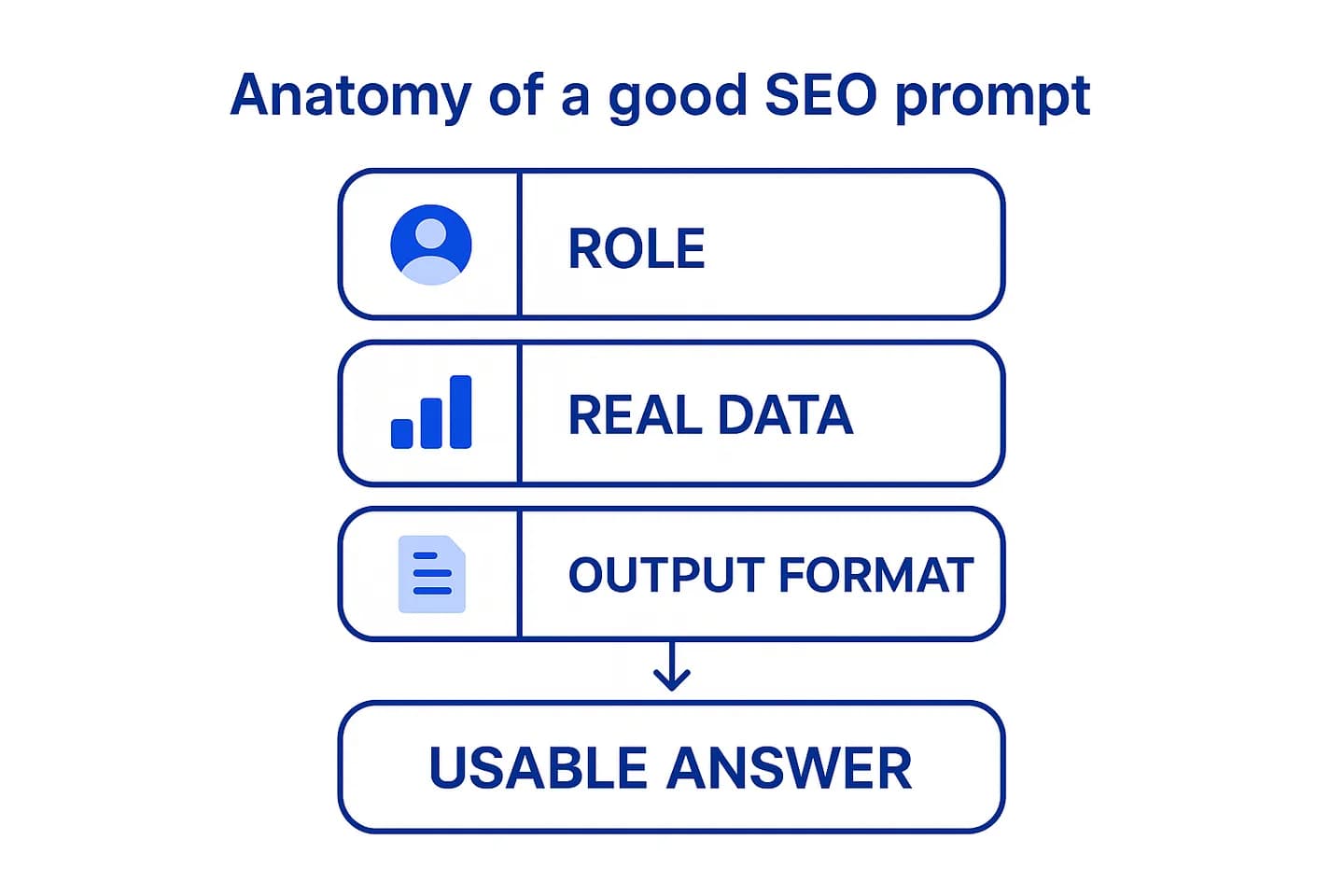
Mistake 1: no role. "Give me SEO tips" and "Act as an SEO strategist working on a B2B SaaS site with 300 indexed pages" produce answers from two different depths. The role sets the vocabulary, the assumptions and the level of detail.
Mistake 2: no output format. "Give me keywords" returns a wall of text you then have to reformat. Ask for a table with named columns and you get something you can paste into a spreadsheet or a brief without touching it.
Mistake 3: no real data. This is the expensive one. ChatGPT cannot see your Google Search Console, your rankings, your competitors or your pages unless you paste them in, and when it has no data it fills the gap with plausible fiction. Search volumes are the classic example: the numbers look credible and they are made up.
There is a fourth, subtler reason, and it is structural: prompts are not keywords. Semrush cross-referenced real ChatGPT prompts against its database of over 27 billion keywords and found that between 65% and 85% of prompts could not be matched to any traditional search keyword, per its ChatGPT search insights study. People write to ChatGPT the way they would brief a colleague, and the model expects the same from you.
A prompt is a brief, not a query. The best mental model I know: write the prompt you would send to a junior SEO who has never seen your site and cannot ask you questions. Everything that person would need, the model needs too.
🔍 ChatGPT prompts for keyword research
Keyword research is where ChatGPT earns its keep, on one condition: never ask it for search volumes. It cannot know them, so it invents them. Take the volumes from Google Search Console, Keyword Planner, Ahrefs or Semrush, and use ChatGPT for what it is genuinely good at, which is clustering, intent mapping and finding angles you would not have thought of alone.
Prompt 1: the long-tail keyword table
Act as an SEO strategist specializing in [your industry].
Give me 20 long-tail keywords for the topic "[your topic]".
Output a table with 4 columns: keyword, search intent (informational /
commercial / transactional), estimated difficulty (low / med / high), and
the best content format to rank for it (blog post, landing page,
comparison page, tool page).
Do not estimate search volume.What to expect: a structured table you can drop straight into a brief or a spreadsheet. The intent column alone saves around thirty minutes of manual SERP checking, and the last line of the prompt is what stops the model inventing volumes.
Prompt 2: cluster a keyword list into a content plan
Here is a list of keywords exported from my SEO tool: [paste keywords].

Group them into topical clusters for a pillar-and-cluster strategy.
For each cluster: name the pillar topic, list the supporting keywords,
give the primary search intent of the pillar page, and say whether the
cluster deserves a new page or an update to an existing one.What to expect: a content architecture you can hand to a writer or turn into an editorial calendar. This is the single highest-leverage keyword prompt in the list, because clustering is tedious for a human and instant for a model.
Prompt 3: question keywords from a persona
You are [describe your target customer precisely: e.g. "a freelance
graphic designer who charges 80 euros an hour and wants more clients"].

List 20 questions you would type into Google when trying to solve
[specific pain point].
Cover all three stages: becoming aware of the problem, comparing
solutions, ready to buy. Mark each question with its stage.What to expect: keyword angles that sound human, because they come from a human point of view. This is the prompt I use for FAQ sections, People Also Ask targeting and blog topics that competitors have not covered.
Prompt 4: alphabet soup expansion
Act as an SEO keyword researcher.
Generate keyword ideas starting with "[your head term] a", then
"[your head term] b", and continue through the alphabet.
Keep only terms with informational or commercial intent.
Output a flat list, one keyword per line, no commentary.What to expect: a fast sweep of autocomplete-style long-tail terms. It is crude, it is quick, and it regularly surfaces gaps nobody in your niche has written about yet.
📝 ChatGPT prompts for on-page SEO
On-page is where prompting gets precise, because every output has a hard constraint you can check: a character count, a heading level, a keyword placement. Constraints are what make these prompts reliable.
Prompt 5: title tags and meta descriptions at scale
You are an SEO expert specializing in high click-through-rate metadata.

Write 5 title tags (max 60 characters) and 5 meta descriptions
(max 155 characters) for a page targeting "[keyword]".

The page is about [one sentence]. The audience is [describe].
Show the character count next to each line.
Flag which title and meta pairing you would A/B test first, and explain
why in one sentence.What to expect: five ready-to-test variants with a built-in recommendation. Asking which one it would test first forces the model to reason about click-through rate instead of just filling character counts.
Prompt 6: heading structure audit
You are an SEO content strategist.

Here are the headings from my page: [paste your H1, H2s and H3s].
Target keyword: "[keyword]". Page goal: [rank for X / convert Y].

Flag every heading that: (1) misses a keyword opportunity, (2) does not
nest logically under its parent, or (3) does not match the search intent.
Rewrite each flagged heading and explain the change in five words.What to expect: a line-by-line audit with rewrites. This is the prompt I reach for when I inherit someone else's content and need a structural fix before touching the copy.
Prompt 7: semantic enrichment
Act as an SEO strategist. I am optimizing a page targeting
"[primary keyword]" for [audience].

List 15 semantically related terms, named entities (tools, brands,
standards, concepts) and related questions I should cover on the page.
For each one, suggest the specific section or sentence where it fits
naturally. Exclude anything that would read as keyword stuffing.What to expect: a topical completeness list rather than a keyword density exercise. Covering the entities a topic implies is what search engines and AI answer engines both reward.
Prompt 8: rewrite a thin product or service page
Act as an SEO content expert.

Current content of my [product / service] page: [paste content].
Target keyword: "[keyword]". Audience: [describe].
Conversion goal: [describe].

Rewrite the page to: (1) strengthen keyword signals without stuffing,
(2) answer the top 3 objections a buyer has at this stage, (3) end on a
clear call to action. Keep it under [word count] words and keep every
factual claim from the original.What to expect: a tighter, more conversion-aware page. The objection-handling instruction is the important part, because it forces the model to write like a copywriter instead of like an SEO checklist.
✍️ ChatGPT prompts for SEO content
This is where most people use ChatGPT and where most people get burned. "Write me a 1500 word blog post about X" produces exactly the kind of content that stopped ranking two years ago. Semrush's analysis found that purely AI-generated text takes the top spot only around 9% of the time, while human-written pages rank high in 80% of cases. So use the model for the skeleton and the variants, not for the finished article.
Results from a  ChatSEO customer
From 30 to 600 Google clicks a day
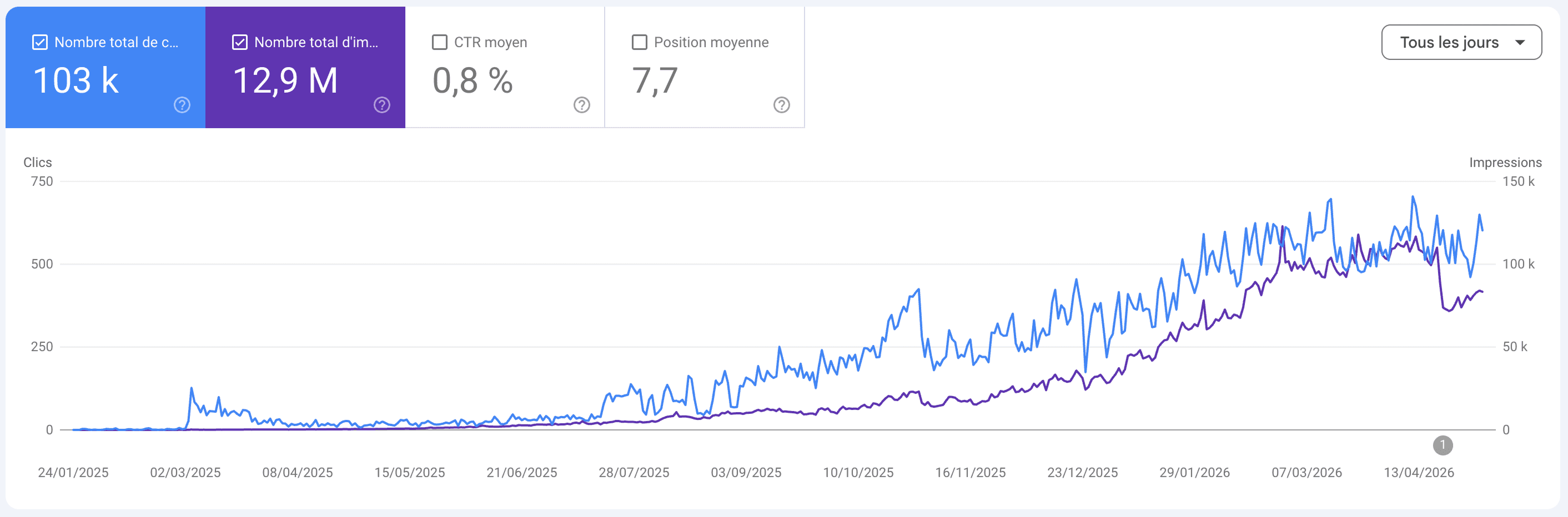

“I tripled my clicks on this site in 3 months.”
Timothée Tabary · Manager, e-commerce stores
Prompt 9: the full content brief
You are a senior content strategist. Write a detailed SEO content brief
for the keyword "[keyword]".

Include:
- Search intent (what the reader actually wants, in one sentence)
- Target audience and what they already know
- Recommended word count with a justification
- Full outline: H1, H2s, H3s
- 5 questions the article must answer
- 3 internal linking opportunities (describe the topic, not the URL)
- 3 angles that beat the pages currently ranking
- Tone, point of view, and what to avoidWhat to expect: a brief you can hand to any writer, including yourself, and get a page built to rank from the first draft. Of all fifteen prompts, this is the one that saves the most hours per month.
Prompt 10: three introductions, no filler
Act as a conversion copywriter who understands SEO.

Write 3 different introductions for an article targeting "[keyword]".
Each one must: (1) open on a pain point the reader recognizes,
(2) contain the primary keyword within the first 100 words,
(3) promise a specific outcome.

Under 100 words each. Ban these openers: "In today's digital landscape",
"In the ever-evolving world of", and any sentence starting with "As".What to expect: three distinct angles (pain point, statistic, story) that you can test. The ban list matters more than the rest of the prompt, because it removes the model's worst reflexes before it writes a word.
Prompt 11: an FAQ built for featured snippets
Act as an SEO content writer.

Write 7 FAQ questions and answers for a page targeting "[keyword]".

Rules:
- Each answer under 60 words
- Each answer self-contained and readable out of context
- Direct answer in the first sentence, detail after
- Format as Q: / A: pairs ready for FAQPage schema
- Use the primary keyword naturally in at least 2 answers
- Base the questions on what people actually ask, People Also Ask styleWhat to expect: a schema-ready FAQ block that targets featured snippets and People Also Ask. The "answer first, detail after" rule is what makes these blocks quotable by AI assistants.
Prompt 12: refresh a page that is losing rankings
You are an SEO content strategist.

Here is an article losing rankings: [paste the article or its key
sections]. Target keyword: [keyword]. Position 6 months ago: [X].
Position today: [Y].

Identify: (1) what is factually outdated, (2) what the pages now ranking
above me cover that I do not, (3) which sections to cut, expand or
rewrite.
Give me a prioritized action list ordered by expected impact, not a full
rewrite.What to expect: a surgical refresh plan. Updating an existing page that already has history is almost always faster than writing a new one, and this prompt is how you decide what to touch.
⚙️ ChatGPT prompts for technical SEO
Technical SEO is where ChatGPT surprises people. It cannot crawl your site, but it writes valid code, audits logic and spots risks in seconds. Always validate the output in a real tool before it goes live.
Prompt 13: generate JSON-LD structured data
Act as a technical SEO expert.

Generate valid JSON-LD structured data for a [blog post / FAQ page /
product page / how-to guide] with these details:
- Title: [title]
- Description: [description]
- Author: [name]
- Published: [date]
- Primary keyword: [keyword]

Output only the JSON-LD code block, using schema.org types that Google
actually supports for rich results. Then list the 3 fields I must
customize before publishing.What to expect: clean JSON-LD you can paste into your head tag. Validate every block with Google's Rich Results Test before shipping, because a schema error is silent and costs you the rich result.
Prompt 14: audit and rewrite robots.txt
Review this robots.txt: [paste file].

Answer three questions:
1. Are GPTBot, OAI-SearchBot, PerplexityBot and Bingbot allowed or
   blocked?
2. Is any directory that contains indexable pages accidentally
   disallowed?
3. Is the sitemap declared correctly and reachable?

Then rewrite the file with safe defaults: allow AI crawlers, disallow
only admin, staging and internal search URLs. Explain each Disallow line
in one sentence.What to expect: a clear audit and a deployable rewrite. This one matters more every quarter: ChatGPT's outbound referral traffic to the rest of the web grew 206% year over year between January 2025 and January 2026, according to Semrush's clickstream study. Blocking those crawlers is now a traffic decision, not a technical detail.
Prompt 15: redirect chain audit
Act as a technical SEO consultant.

Here is my redirect map: [paste source URL to destination URL pairs].

Identify: (1) redirect chains (A to B to C instead of A to C),
(2) redirect loops, (3) 302s that should be 301s, (4) destinations that
are not 200 status codes.

Output a table: Source URL | Current redirect | Issue | Recommended fix.
Sort by severity.What to expect: a prioritized fix list. Redirect chains waste crawl budget and dilute link equity, and this prompt finds them faster than any manual review of a spreadsheet.
📊 The workflow that changes everything: Search Console plus ChatGPT
Here is what separates people who get real value from ChatGPT from people who collect prompts: the data they feed it. Your Google Search Console holds the only numbers about your site that are not an estimate, and it is free.
Path A: the manual way
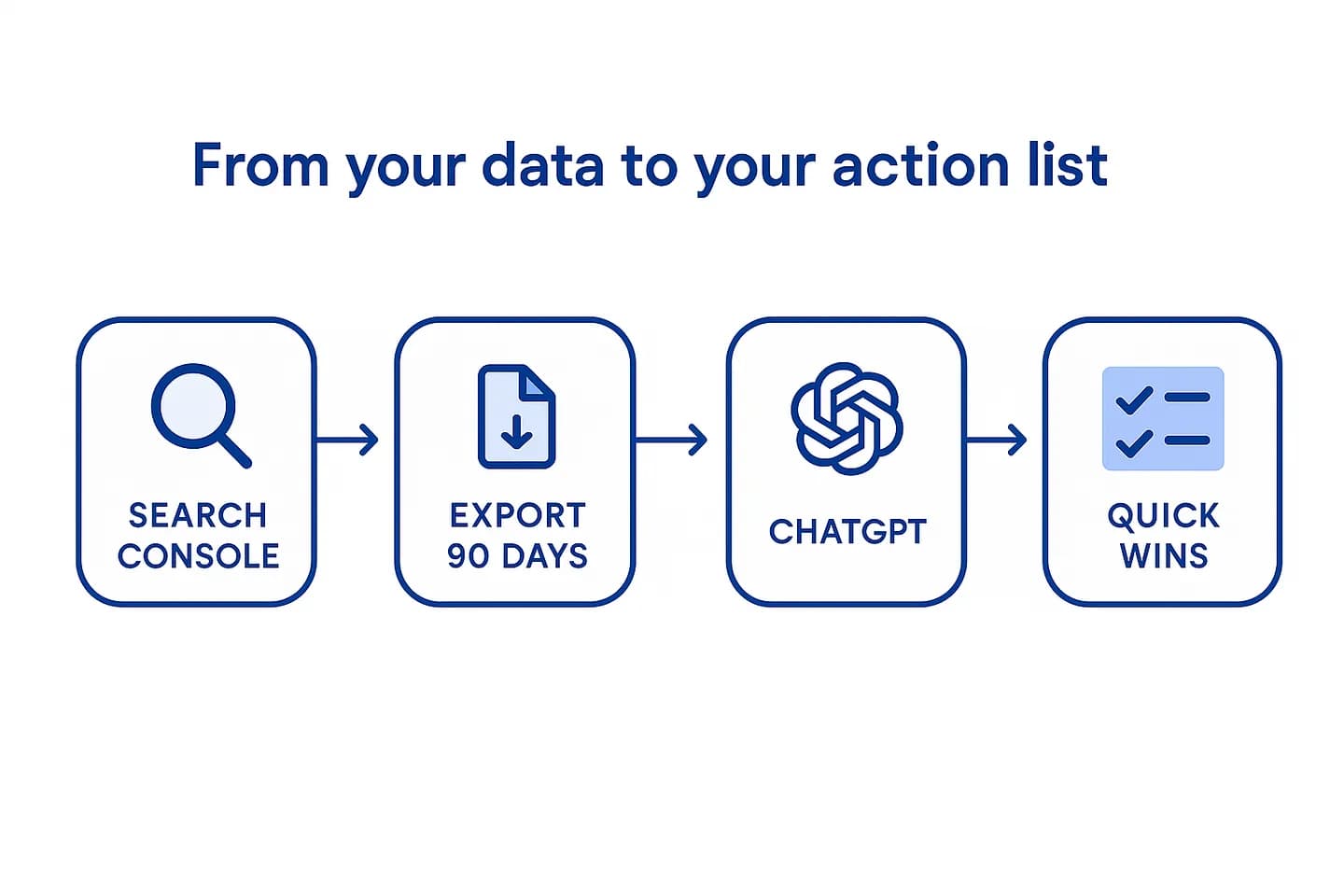
Step 1. Open Search Console, go to Performance, set the range to the last 90 days, and export queries and pages with clicks, impressions, CTR and average position.
Step 2. Paste the relevant rows into ChatGPT with this prompt:
Here is my Google Search Console export (queries, pages, clicks,
impressions, CTR, average position, last 90 days): [paste rows].

1. Group the queries into topical clusters.
2. Flag every page with more than 500 impressions and a CTR under 3%,
   and give one specific fix per page.
3. List my position 8 to 15 quick wins, ordered by potential clicks
   gained.
Do not invent data that is not in the export.Step 3. Act on the quick wins first. A rewritten title tag or a new H2 on a page sitting at position 11 moves it to page one far faster than any new article, and it costs you twenty minutes.
The limits of this path are real: the export step, the context window on big sites, and the fact that you have to redo it every month. For a site with 30 pages it is fine. For 3000, it collapses.
Path B: connect the data instead of pasting it
ChatSEO is the ChatGPT for SEO: the same conversation, except it is already connected to your Google Search Console. The AI knows your queries, positions, impressions and click-through rates before you ask anything. You type "which pages have high impressions but low CTR" and get an answer from your live data, with no export, no spreadsheet and no formatting step.
Verified pricing, from the official ChatSEO pricing page in September 2026: Starter is €29/month billed monthly and €23/month billed annually (100 credits, 1 connected site), Pro €49/month (€39 annually, 200 credits, 3 sites) and Ranker €79/month (€63 annually, 400 credits, 10 sites), with free trial credits to test it.
Who should not bother: if you manage one small site and enjoy the spreadsheet, Path A costs nothing and works. The connected version earns its price when you manage several sites, or when you want the same analysis every week without redoing the export.
⚖️ The five rules behind every good SEO prompt
- ✅ Always assign a role. "Act as an SEO strategist for [industry]" changes the depth of every answer that follows.
- ✅ Always impose the output format. Table with named columns, numbered outline, five variants under 60 characters. Vague in, vague out.
- ✅ Always give real data. Your page, your keyword list, your Search Console rows. Data is what turns a text generator into an analyst.
- ❌ Never trust a number it produced alone. Search volumes, difficulty scores and traffic estimates from ChatGPT are fiction. Take them from Search Console or a data tool.
- ❌ Never ship technical output unvalidated. Schema goes through the Rich Results Test, robots.txt and redirects get tested on staging first.
One more habit that beats any prompt library: iterate instead of accepting. If the first output is 70% right, say "make it more direct", "cut this to three bullets", or "you invented the volumes, remove that column". The second answer is almost always the usable one, and most people never ask for it.
🚧 What ChatGPT still cannot do for your SEO
Being honest about the ceiling is what makes the rest of this article usable. ChatGPT does not crawl your site, does not know your rankings, does not see your backlinks, and does not have live SERP data unless it runs a search.
And it searches less often than people assume: ChatGPT enables its search feature on just 34.5% of queries as of February 2026, down from 46% in late 2024, according to Semrush. Most answers still come from training data, which is exactly why an answer about your site, your market or this quarter's prices needs your data pasted in.
It also cannot judge whether a page deserves to exist. Deciding between updating a page that already ranks at position 12 and writing a new one is a call that requires history, and history lives in Search Console, not in the model.
Who should not build an SEO workflow on prompts alone: anyone managing more than a handful of sites, and anyone who needs backlink or competitor databases. For those jobs you still need real tools. See our tier list of 52 SEO and GEO tools for what is genuinely worth paying for.
🔍 Keep reading
- The best AI SEO tools in 2026, the tools built on top of these prompts
- AI SEO agent: what it does that a chatbot cannot, the next step after prompting
- How to analyze a website for SEO, the full audit method these prompts plug into
- SEO tools tier list 2026, 52 tools ranked from S to D
- The best free SEO tools, what to pair with ChatGPT for nothing
❓ FAQ: ChatGPT SEO prompts
What is the best ChatGPT prompt for SEO keyword research?
The long-tail keyword table (Prompt 1 above). Asking for intent and content format alongside each keyword is what makes it actionable, and adding "do not estimate search volume" is what keeps it honest. Take the actual volumes from Search Console, Keyword Planner, Ahrefs or Semrush.
Are ChatGPT SEO prompts enough to replace an SEO tool?
No, and anyone telling you otherwise is selling a prompt pack. ChatGPT cannot pull live volumes, crawl your site or read your backlinks. It is excellent at structuring, clustering, drafting and generating variants. For real numbers you need Google Search Console plus a data tool, or a tool like ChatSEO that connects to Search Console for you, from €23/month billed annually.
Can Google detect and penalize AI-generated SEO content?
Google's stated position is that it rewards quality content however it is produced, and targets content made primarily to manipulate rankings, per its guidance on AI-generated content. In practice the split is clear: AI-assisted content with real experience and real data performs, generic mass-produced content does not.
How do I get better outputs from my prompts?
Role, real data, output format, in that order. A prompt missing one of the three returns something generic, and the missing piece is almost always the data. Then iterate: ask for the correction instead of accepting the first draft.
Can I use these prompts directly on Google Search Console data?
Yes, and it is the highest-value thing you can do with ChatGPT for SEO. Export the last 90 days, paste the rows, and use the workflow prompt above. The limits are the export step and the context window, which is what a natively connected tool removes.
How often should I update my prompt library?
Once a quarter is enough. Models change, SERP features change, and prompts get shorter over time. The skeleton never changes: role plus data plus output format.
🏁 Conclusion: the prompt is not the hard part
After three years of using these prompts on client sites, the pattern is boring and consistent: the quality of the answer tracks the quality of the data you pasted in, not the cleverness of the wording. A mediocre prompt on real Search Console rows beats a beautiful prompt on nothing.
So start with the three prompts at the top, keep the fifteen in a note, and spend your energy on the input rather than on collecting more prompts. That is the whole method.
- Semrush, ChatGPT search insights, clickstream study on prompts and referral traffic
- SEOProfy, AI SEO statistics, AI adoption among marketers
- Google Search Central, AI-generated content guidance
- Google Rich Results Test, to validate every schema block
- ChatSEO pricing, plans and credits verified in September 2026